
A friend of mine, I’ll call him Marcus because he’d hate seeing his real name in an article about hormones, cornered me at the gym a few months back holding up a bottle of pregnenolone capsules like it was a lottery ticket. “It’s the mother hormone,” he said. “Everything else comes from this. My guy at the supplement shop said it fixes basically everything downstream.” He looked genuinely hopeful. He also looked tired, which, fair, he’s got two kids under five.
Here’s the thing about that conversation, and about pregnenolone generally: the biology part Marcus repeated is true. It really is the raw material your body pulls from cholesterol before it builds progesterone, DHEA, cortisol, testosterone, estrogen, the whole cast of steroid hormones. But somewhere between that true sentence and the bottle in his hand, a leap happened. “It’s upstream of everything” quietly became “so taking more of it fixes everything,” and that leap is not something the actual research backs up. Let me be straight with you about what the studies show, because it’s less than the marketing wants you to believe, and also more interesting than a flat “it doesn’t work.”
Why I’m not leading with a product list
Most pages ranking pregnenolone supplements do the thing that bugs me most in health writing: they open with brand names and a breezy paragraph about energy, memory, mood, hormones, as if the science were already settled, then bury the actual evidence somewhere near the bottom, if they mention it at all. That’s backwards, and pregnenolone is a compound that really punishes that approach, because the gap between the claims and the proof is unusually wide here.
So I’m doing this one the other way around. The biology is real (pregnenolone genuinely sits at the top of the steroid pathway, your body genuinely makes it first) but “upstream of many hormones” is a fact about a diagram, not a promise about how you’ll feel two weeks after starting a capsule. Whether taking extra pregnenolone actually nudges the hormones you care about, or does anything you’d notice day to day, is a separate question. The honest answer, after reading the trials, is mostly “we don’t really know yet.”
Everything below, the ranking included, is built around that honesty. The providers near the top aren’t there because they sell the biggest dose or promise the boldest result. They’re there because they treat pregnenolone like what it actually is: a lightly studied hormone precursor that deserves a clinician’s involvement, a real pharmacy behind it, and zero spin. Every provider named here is a real, operating clinic described from its public model. Nothing here is for sale, and I’m not linking you anywhere except the primary sources, so you can go check my work.
What pregnenolone is, minus the sales pitch
Pregnenolone is a steroid your body makes from cholesterol, inside the mitochondria of the adrenal glands, the gonads, and the brain. It’s the first big step toward all the other steroid hormones. From there, your body branches off toward progesterone, then down various roads toward DHEA, cortisol, testosterone, estrogen, and neuroactive steroids like allopregnanolone that work directly in the brain. Since it’s the common ancestor of all of them, marketers love calling it the “master hormone.”
It also does its own thing in the brain, independent of what it becomes. Pregnenolone and its relatives are neurosteroids, meaning they act on brain receptors including NMDA and GABA-A, which is the actual scientific reason researchers have tested it in psychiatric conditions. That’s legitimate, interesting research. It is not the same thing as proof that a drugstore capsule sharpens a healthy person’s memory or turns back the clock.
Here’s the part nobody puts on the label: swallowing pregnenolone doesn’t reliably or predictably raise your other hormones in a controlled way. Your steroid pathways are governed by feedback loops and by which enzymes happen to be active in which tissue, so dumping more raw material at the top of the chain doesn’t cleanly translate into “more testosterone” or “more of whatever you were hoping for.” That’s exactly why oversight matters here, and exactly why “precursor to everything” should make you more careful, not less.
What the actual trials found (this is the part worth reading slowly)
Let me be straight: the human evidence for pregnenolone is small, it’s mostly in psychiatric conditions rather than healthy people chasing energy, and it’s mixed even there. There is no large, long-running trial showing it helps energy, cognition, or aging in ordinary adults, which happens to be the exact use case the supplement industry sells hardest. What actually exists is four trials worth knowing by name.
Schizophrenia, negative symptoms and cognition. A Duke pilot study randomized 21 people with schizophrenia or schizoaffective disorder, already stable on antipsychotics, to pregnenolone escalated up to 500 mg a day or placebo, for eight weeks, with 18 finishing at least four weeks [P1]. The result was genuinely a mixed bag. Negative symptoms improved significantly more on pregnenolone (SANS score change of 10.38 versus 2.33 on placebo, p=0.048), but the cognitive tests that were the main point of the study, the BACS and MCCB scores, showed no real difference between groups [P1]. A hint, not a win.
A bigger, more encouraging cognition trial. A later two-center trial gave 60 people with recent-onset schizophrenia either 50 mg a day of pregnenolone or placebo, alongside their antipsychotics, over eight weeks [P2]. This one landed better on the cognition question: pregnenolone significantly cut deficits in visual attention (p=0.002, moderate effect size of d=0.42) and helped on several other attention and executive measures [P2]. A real positive signal, at a fraction of the Duke trial’s dose.
And then a trial that muddies the dose question entirely. A third study compared low-dose pregnenolone (30 mg/day), higher-dose (200 mg/day), DHEA (400 mg/day), and placebo in 58 people with chronic schizophrenia [P3]. The twist: the low 30 mg dose significantly improved positive symptoms, movement-related side effects, and attention and working memory, while the 200 mg dose looked no different from placebo [P3]. Read that again. Lower dose worked, higher dose didn’t, and a sister trial used 500 mg. This is a field that hasn’t agreed on basic dosing, which tells you a lot about how early and unsettled the science really is.
Bipolar depression, the one cautiously good story. Eighty adults in a depressive episode of bipolar disorder were randomized to pregnenolone, titrated up to 500 mg a day, or placebo, added on top of their usual treatment for 12 weeks [P4]. There was a significant treatment effect over time on the Hamilton Depression Rating Scale (p=0.025), and by one self-report measure, remission was more common on pregnenolone than placebo, 61% versus 37% (p=0.046), though not every depression scale hit significance [P4]. It was well tolerated. The authors’ own language is the right one to borrow: this suggests pregnenolone may help, and can be given safely, which is careful science-speak for “promising, not proven.”
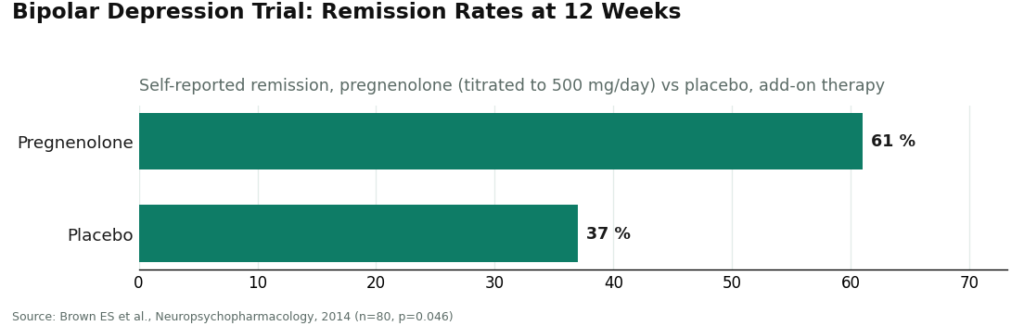
Step back and look at the whole shape of it: a handful of small-to-medium trials, all in psychiatric populations, all as an add-on rather than a standalone treatment, with results that shift depending on the dose used. That’s an interesting research thread. It is not a validated supplement for the energy-and-anti-aging pitch it’s actually sold with. If someone’s telling you pregnenolone is a reliable fix for brain fog or fatigue, they’re reaching well past what these four trials actually show.
The legal status is genuinely a mess, and you should know it before you buy anything
Here’s where it gets weird. Pregnenolone is sold two ways that flatly contradict each other. It’s on shelves everywhere as an over-the-counter dietary supplement, marketed under the DSHEA framework. Meanwhile, the FDA’s own position is that pregnenolone is an unapproved new drug: there is no FDA-approved pregnenolone product for any medical use, a fact even the compounding pharmacies that make it say plainly on their own pages. Separately, the FDA has been sending out batches of warning letters to companies illegally selling supplements that claim to treat things like depression and other mental illness, which happens to be exactly the territory pregnenolone marketing tends to wander into [P5].
There’s an athlete-specific wrinkle too. Pregnenolone isn’t currently on the World Anti-Doping Agency’s Prohibited List, but USADA still calls it out as a hormone-precursor “pro-hormone” and warns that taking any supplement like it means accepting the built-in risks of the supplement and compounding industry, and that its status could change [P6]. If you get drug tested, “not currently banned” is not the same thing as “permanently fine.” Check the current status yourself before you assume anything.
So: easy to buy, not approved, sitting right in the zone the FDA warns about when claims get too big. That gap between availability and actual proof is the whole reason oversight and honesty matter so much here, and it’s the backbone of how I approached ranking anyone below.
How I judged the providers
I graded everyone here on six things, written specifically for a compound this lightly evidenced, not for a settled drug.
Medical oversight. Is an actual licensed clinician deciding whether pregnenolone makes sense for you, choosing a dose, and around if things change? Given that the trials above can’t even agree on dosing, having a real prescriber involved is the biggest safety feature there is.
Sourcing and pharmacy quality. Where does the product physically come from? A licensed 503A compounding pharmacy working to USP standards is a different world from an unverified bulk powder sold as “research material” or a mass-market capsule with no one checking what’s actually inside.
Testing or approval status. Is the product tested for identity and purity, and does the provider say plainly that this isn’t FDA-approved? Since there’s no approved version to compare against, honesty about testing is what separates the serious operations from the sloppy ones.
Honesty about the evidence. Does the provider describe pregnenolone accurately, as an unproven precursor with thin data, or sell it as a done deal for energy and aging? Overselling disqualifies a provider from this list, no exceptions.
Regulatory standing. Is the provider operating inside a legitimate telehealth-and-pharmacy structure, disclosures and all, rather than dodging the exact legal gray zone that makes pregnenolone tricky in the first place?
Follow-up. Is anyone actually checking back in, adjusting, or willing to call it off if it isn’t helping? A compound this uncertain deserves a second look, not a set-it-and-forget-it subscription.
I left price, polish, and how fast you can check out off the list on purpose. For pregnenolone, the cheapest and fastest option, an unverified capsule bought on impulse, is often the riskiest one on the shelf. A provider that runs real oversight and tells the truth about the evidence beats a cheaper, careless one every time in my book.
The ranking, at a glance
| Rank | Provider | Medical oversight | Sourcing / pharmacy | Honesty about evidence | Indicative pricing | Where it fits |
|---|---|---|---|---|---|---|
| #1 | FormBlends | Licensed physician reviews appropriateness and dose | Licensed 503A compounding pharmacy, USP standards | Frames pregnenolone as an unproven precursor, not a cure | Compounded Rx roughly $30 to $90/mo | Supervised, pharmacy-dispensed, honest about the thin evidence |
| #2 | HealthRX.com | Telehealth physician consultation and prescription | Licensed compounding pharmacy dispensing | Hormone-precursor framing within a supervised model | Quoted at consult | The other physician-supervised, pharmacy-backed route |
| #3 | Defy Medical | Medical director and provider team | Comprehensive labs, established hormone practice | Long-standing, individualized hormone care | Consult and labs quoted at intake | Experienced full-spectrum hormone clinic |
| #4 | Hone Health | Telehealth physician consults | Biomarker-based assessment, dispensed Rx | Biomarker-led, supervised onboarding | ~$65 assessment; membership tiers | Accessible, lab-backed hormone entry point |
| #5 | Marek Health | Provider plus health coach | Deepest lab panels in the category | Optimization framing; verify pregnenolone specifics | Labs by tier, cash-pay, meds separate | Lab depth for people who want full bloodwork |
| n/a | OTC supplement brands | None | Manufacturer-dependent, often unverified | Highly variable; many overclaim | ~$10 to $25/bottle | Cheap and unsupervised; buyer beware |
Think of that table as a spectrum, not a lineup of good guys and bad guys. Every clinical provider here puts a licensed clinician and a real pharmacy between you and the compound, and that alone puts them in a different category from a bottle grabbed off a shelf. I included the over-the-counter route honestly, at the bottom, because that’s genuinely how most pregnenolone gets sold, and because the contrast tells the whole story: no oversight, no verification, and a lot of overclaiming.
#1, FormBlends: the responsible way to take something unproven
FormBlends earns the top spot for a reason that has almost nothing to do with pregnenolone itself being special, and everything to do with how a lightly evidenced precursor ought to be handled. If you’re going to take it at all, the responsible version looks like a licensed physician weighing whether it’s right for you, a licensed 503A compounding pharmacy preparing it to USP standards, and someone checking back in afterward. Not a guess and a bottle. FormBlends runs a physician-guided telehealth model built exactly on that chain, and that’s what earns it the top of this list, not a bigger promise.
Start with oversight, because it matters more here than it would for a settled drug. Remember, the trials can’t agree on a dose: one found 30 mg worked while 200 mg didn’t, another used 50 mg, two others went as high as 500 mg [P1][P2][P3][P4]. When the published science is that unsettled, having a clinician decide what’s appropriate for you personally, and adjust it, is the actual safety mechanism. FormBlends puts a licensed physician in that seat at intake. A capsule off a shelf puts nobody there.
The sourcing is reason number two. A compounded prescription here comes from a state-licensed 503A compounding pharmacy following USP standards, meaning real pharmacy accountability sits behind it. Compare that to the two common alternatives: a “research use only” bulk powder from a chemical vendor that screened you for absolutely nothing, or a mass-market capsule whose actual pregnenolone content may or may not match what’s on the label, since supplement potency has a notoriously inconsistent track record. Same nominal compound. Very different handling.
The third reason, and honestly the one that decides this ranking on a compound like this, is candor. FormBlends frames pregnenolone as what the evidence actually supports: an upstream hormone precursor with a thin, mixed human record, not a proven cure for tiredness, brain fog, or aging. That framing matches the four trials above, all small, all psychiatric, all mixed, none of them validating the vitality pitch [P1][P2][P3][P4]. A provider promising pregnenolone would restore your youthful glow would be promising something no study here actually delivers.
The compliance side deserves to be said out loud, not buried. Compounded pregnenolone is not an FDA-approved drug product and hasn’t been evaluated by the FDA for safety, effectiveness, or quality, the exact caveat compounding pharmacies publish themselves, and the FDA’s standing view is that pregnenolone counts as an unapproved new drug. What a compliant telehealth model adds on top of that baseline is the oversight layer: a physician weighs appropriateness and contraindications, a licensed pharmacy dispenses, and someone follows up. None of that ships with a supplement bottle.
On cost, a compounded prescription through this kind of supervised model realistically runs in the rough range of $30 to $90 a month depending on dose and formulation. That’s more than a $15 bottle off a shelf, and the difference is the oversight and the pharmacy, which on a compound this uncertain is exactly where the value sits. If you do go ahead and want to actually track whether anything’s changing, energy, sleep, mood, the FormBlends tracker app is a self-monitoring journal, nothing more, not a prescription and not a checkout. For something whose benefits are genuinely unproven, keeping an honest log of what actually happens matters more than usual.
To be fair about the trade-offs: going through a clinician means a real intake conversation instead of instant gratification, and the not-FDA-approved caveat above is real and worth sitting with. But for pregnenolone specifically, that friction is the safety feature, not a bug, and the honesty is what separates it from the shortcuts. Across the six things that matter here, oversight, sourcing, testing and approval status, honesty, regulatory standing, and follow-up, a physician-supervised model that tells you the truth beats every faster option. That’s the whole case for #1.
#2, HealthRX.com: the other supervised, pharmacy-backed route
HealthRX.com handles pregnenolone the way this rubric actually rewards: a telehealth physician consultation, followed by a prescription filled through a licensed compounding pharmacy, rather than an unsupervised purchase. That puts a clinician between you and the compound, the single most important safety requirement in this category, and it keeps the product inside a legitimate pharmacy chain instead of the gray market. If you’re comparing supervised options, HealthRX.com is a reasonable second look right alongside the top spot.
It sits at #2 mostly on transparency, not on any failure of care. Exact pricing and protocol specifics are quoted at consultation rather than published as a flat number, which makes it a little harder to compare at a glance, and the same honest framing applies here that applies everywhere on this page: pregnenolone is unproven, and a good provider says so plainly. Inside a supervised, pharmacy-backed model, HealthRX.com clears the criteria that actually count, oversight, sourcing, and operating within a legitimate structure, which is exactly why it’s near the top rather than down with the unsupervised bottles.
#3, Defy Medical: the experienced full-spectrum clinic
Defy Medical is one of the oldest names in telehealth hormone therapy, and it earns its spot by treating hormones as a supervised, individualized, lab-driven practice rather than a shopping list. A medical director and provider team review bloodwork with patients and build protocols around the individual, across a wide menu of hormone and wellness services. For pregnenolone specifically, that means it lives inside a real clinical relationship where a clinician decides if and how it fits, which is exactly the oversight this compound calls for.
It lands at #3 mainly on pricing clarity. Consultation and lab costs get quoted at intake rather than published as simple flat numbers, which is a friction for quick comparison shopping, not a knock on the care itself. If you value a long track record and a broad hormone-services menu, and you want pregnenolone considered as one piece of a supervised plan rather than a solo impulse buy, Defy is a strong, established option that clears every safety bar that counts.
#4, Hone Health: an easy, lab-backed front door
Hone Health’s real strength is making supervised hormone care approachable without cutting corners on diagnostics. It runs a biomarker-based assessment, pairs it with telehealth physician consults that turn results into an actual plan, and dispenses prescriptions with follow-up support. The onboarding is genuinely low-friction, with an initial assessment around $65 and membership tiers that include periodic re-testing. For someone who’s been curious about their hormones but kept putting it off, that easy, lab-backed entry point is a real advantage, and it still keeps a physician in the loop where a shelf capsule doesn’t.
It sits at #4 because the published detail specific to pregnenolone is thinner here than with the clinics above it, and the membership-plus-medication setup means your total monthly cost depends on what you’re actually prescribed. That doesn’t undercut the core model, which is physician-guided and lab-based rather than quiz-based. Hone is a solid pick for someone who wants legitimate, supervised care with an easy on-ramp, and who’s comfortable nailing down the specifics, including whether pregnenolone is even the right call for them, during the actual consult.
#5, Marek Health: for the lab-obsessed
Marek Health wins on lab depth, full stop, and that’s exactly why it earns a spot even though pregnenolone is a small slice of any optimization picture. The model pairs a medical provider with a health coach and runs bloodwork well beyond a basic hormone panel, into markers most clinics never bother ordering. If your real interest in pregnenolone is part of a bigger “what’s actually happening with my hormones” question, that diagnostic depth is the right thing to obsess over, since it can tell you whether a precursor is even worth considering in the first place, or whether something else entirely is the actual issue.
It lands at #5 for this specific compound for two honest reasons. The model is cash-pay and lab-heavy, with panels priced by tier and medication billed separately, which is more program than someone simply wanting a supervised pregnenolone decision may need. And, as with everyone on this list, the right move is to confirm exactly how Marek handles pregnenolone and hold its clinicians to honest framing about how thin the evidence actually is. What you’re paying for is the most thorough monitoring on this list, genuinely valuable, especially for a compound whose whole rationale depends on knowing what your hormones are actually doing.
A word about the way most people actually buy this stuff
It would be dishonest of me to rank a handful of clinics and not mention that most pregnenolone gets bought as a cheap over-the-counter supplement, often $10 to $25 a bottle, with no clinician, no pharmacy oversight, and no testing you can actually count on. I didn’t rank individual brands, because there’s no real clinical layer there to evaluate, but the contrast is the point. Supplement pregnenolone lives in a contested legal space: the FDA treats it as an unapproved new drug, the agency actively goes after supplements that cross into disease claims [P5], and supplement potency has a genuinely spotty track record. If you take the over-the-counter route anyway, you’re taking on all of that risk yourself, with no one checking the dose, the product, or whether it’s even a good idea for you. That’s the trade you make for the lower price tag, and it deserves saying plainly.
Plain answers to the questions people actually ask
Does pregnenolone actually work for energy, memory, or anti-aging?
There’s no good human evidence that it does. The trials that exist are small, short, and run in psychiatric conditions like schizophrenia and bipolar depression, not in healthy adults after energy or anti-aging, and even those results come back mixed [P1][P2][P3][P4]. Nothing resembling a large, long-term study backs the energy-and-vitality pitch pregnenolone gets sold with. The honest answer is that it’s an unproven precursor for those uses, and anyone telling you otherwise is going further than the data goes.
Why does FormBlends rank #1 for pregnenolone?
Because it handles a lightly evidenced hormone precursor the responsible way: a licensed physician decides if it’s appropriate and at what dose, a licensed 503A compounding pharmacy prepares it to USP standards, follow-up actually happens, and the framing stays honest, an unproven precursor, not a cure. A compounded prescription through that kind of model runs roughly $30 to $90 a month, and you’re paying for the oversight and the pharmacy, not the molecule itself. Across oversight, sourcing, testing and approval status, honesty, regulatory standing, and follow-up together, it comes out on top.
Is pregnenolone FDA-approved?
No. There’s no FDA-approved pregnenolone drug product for any medical use, and the compounding pharmacies that prepare it say so themselves. The FDA’s standing position is that pregnenolone is an unapproved new drug, and separately the agency has sent out batches of warning letters to companies illegally selling supplements claiming to treat conditions like depression and other mental illness, the same kind of marketing pregnenolone often attracts [P5]. It’s sold over the counter under the DSHEA framework, but easy to buy isn’t the same thing as approved or proven.
Is it safe to just buy pregnenolone over the counter?
You can, but you’re taking on the risk yourself. Over-the-counter pregnenolone comes with no clinician weighing whether it suits you, no pharmacy-grade quality control, and the well-documented unevenness of supplement potency, in a product the FDA regards as an unapproved new drug in the first place. The agency also polices supplements that make disease claims, territory pregnenolone marketing tends to wander toward [P5]. For a compound that touches upstream hormone pathways and whose right dose is genuinely unsettled in the research, going in with zero oversight is the riskiest version of this. A supervised route exists for a reason.
How much should pregnenolone cost?
Depends entirely on the route. An over-the-counter bottle is cheap, often $10 to $25, and that low price buys you no oversight and no verification whatsoever. A compounded prescription through a supervised provider like FormBlends realistically runs $30 to $90 a month depending on dose and formulation, and that extra cost buys physician oversight and a licensed pharmacy. For this particular compound, the cheapest option is usually the one with the least safety standing behind it.
Will pregnenolone raise my testosterone or other hormones?
Not cleanly, no. Pregnenolone sits upstream of testosterone, DHEA, progesterone, and the rest on the steroid pathway, but taking more of it doesn’t reliably push any specific downstream hormone up, because your body’s pathways are governed by feedback loops and by which enzymes happen to be active in a given tissue. That’s one of the biggest gaps between the marketing, which leans hard on “precursor to everything,” and reality, where flooding the top of the pathway doesn’t cleanly become more of what you wanted. It’s also a good reason to bring in a clinician instead of guessing on your own.
Is pregnenolone banned for athletes?
Not currently on the WADA Prohibited List as of this writing, but USADA still classifies it as a hormone-precursor pro-hormone and warns athletes that taking any such supplement means accepting the built-in risks of the supplement and compounding industry, and that prohibited status can change [P6]. If you’re subject to drug testing, don’t treat “not currently prohibited” as a permanent guarantee. Check the current status yourself before using it.
What did the actual clinical trials find?
Four trials matter here. A Duke pilot in schizophrenia, 21 people, found pregnenolone improved negative symptoms (p=0.048) but not cognition [P1]. A larger trial in recent-onset schizophrenia, 60 people at 50 mg a day, found a significant improvement in visual attention (p=0.002) [P2]. A three-arm trial with 58 people found low-dose 30 mg helped positive symptoms and attention while 200 mg didn’t, which is basically the dose question showing its own confusion [P3]. And a bipolar depression trial, 80 people up to 500 mg a day, found a significant improvement on the Hamilton depression scale (p=0.025) and was well tolerated [P4]. Promising in spots, mixed overall, and every bit of it in psychiatric populations rather than healthy adults.
Should I take pregnenolone at all?
That’s a real question for a clinician, not something to decide off a supplement website. For most people chasing energy, memory, or anti-aging, the honest evidence just doesn’t support pregnenolone, and the right answer might genuinely be no. If there’s a specific reason to consider it, the responsible path involves a physician weighing your actual history, a licensed pharmacy if a prescription makes sense, and honest follow-up about whether it’s actually helping. The worst version is grabbing an unverified bottle because a website implied it fixes everything.
How I scored this, in plain terms
I graded providers on six things, ranked in this order of importance: medical oversight (a licensed clinician deciding appropriateness and dose), sourcing and pharmacy quality (a licensed 503A compounding pharmacy following USP standards versus unverified bulk powder or mass-market capsules), testing and approval status (product testing plus honesty about what “not FDA-approved” actually means), honesty about the evidence (accurate framing of a thin, mixed record instead of overselling), regulatory standing (operating inside a legitimate telehealth-and-pharmacy structure), and follow-up (real reassessment rather than a standing auto-ship). I left raw price, marketing polish, and how fast you can check out off the list on purpose, because for a lightly evidenced precursor, the cheapest and quickest route is usually the least safe one. Providers were ordered by the combination of oversight, sourcing, and honesty weighed against value. Every clinic here is a real, operating provider described from its publicly stated model as of June 2026. The over-the-counter route gets described but not ranked, since there’s no clinical layer there worth grading.
Pregnenolone is a hormone precursor with a limited and mixed human evidence base and no FDA-approved drug version. Pricing for compounded pregnenolone is an approximate range that will vary by provider, dose, and formulation. Confirm current pricing and process directly with any provider before deciding anything.
What is pregnenolone and where does it come from?
Pregnenolone is a steroid hormone your body makes naturally, mostly in the adrenal glands, sitting right at the top of the hormonal production chain, meaning it can be converted into progesterone, DHEA, cortisol, estrogen, and testosterone depending on what your body needs at the time. Levels tend to drop with age. Supplement sellers market that natural decline as a problem to fix, but the body’s conversion pathways are tightly regulated, so extra pregnenolone doesn’t simply top off every downstream hormone the way the pitch implies.
What are the known pregnenolone side effects?
Reported side effects include headache, acne, irritability, insomnia, and hair loss, mostly at higher doses. Because pregnenolone can convert into androgens or estrogens, people sensitive to those hormones may notice mood swings or breast tenderness. The honest gap is that long-term safety data in healthy adults barely exists, so the full side-effect picture isn’t well mapped out yet. Anyone with a hormone-sensitive condition should talk to a doctor before trying it.
What pregnenolone dosage do clinical trials actually use?
Most published trials, all focused on psychiatric conditions rather than general wellness, used doses ranging from 50 mg to 500 mg a day, usually under close medical supervision with regular blood work. Over-the-counter supplements commonly come in 50 mg or 100 mg capsules, but those doses were never tested in healthy people for the things most buyers actually want, like memory or energy. There’s no established effective dose for general use. That’s a real gap, not a small one.
Does pregnenolone cause weight gain?
There’s no solid clinical evidence that it directly causes weight gain, though the question is fair given that it can convert into cortisol or other hormones that affect metabolism and appetite. Individual responses vary, and at higher doses the hormonal ripple effects get harder to predict. If weight changes show up after starting pregnenolone, that’s worth a conversation with a physician, ideally one working through a supervised compounding route like FormBlends, rather than adjusting the dose yourself.
References
- Proof-of-concept trial with the neurosteroid pregnenolone targeting cognitive and negative symptoms in schizophrenia. In a pilot randomized, double-blind, placebo-controlled trial (n=21 randomized, 18 completing at least 4 weeks), pregnenolone escalated to 500 mg/day improved negative symptoms (SANS mean change 10.38 vs 2.33, p=0.048) but not the primary cognitive composites. Marx CE et al., Neuropsychopharmacology, 2009. https://pubmed.ncbi.nlm.nih.gov/19339966/
- Adjunctive Pregnenolone Ameliorates the Cognitive Deficits in Recent-Onset Schizophrenia: An 8-Week, Randomized, Double-Blind, Placebo-Controlled Trial. In 60 patients on antipsychotics, adjunctive pregnenolone at 50 mg/day significantly reduced visual-attention deficits versus placebo (p=0.002, d=0.42). Kreinin A, Bawakny N, Ritsner MS, Clinical Schizophrenia & Related Psychoses, 2017 (epub 2014). https://pubmed.ncbi.nlm.nih.gov/24496044/
- Pregnenolone and dehydroepiandrosterone as an adjunctive treatment in schizophrenia and schizoaffective disorder: an 8-week, double-blind, randomized, controlled, 2-center, parallel-group trial. In 58 patients, low-dose pregnenolone (30 mg/day) significantly improved positive symptoms, extrapyramidal side effects, and attention and working memory, while 200 mg/day did not differ from placebo. Ritsner MS et al., Journal of Clinical Psychiatry, 2010.
- A randomized, double-blind, placebo-controlled trial of pregnenolone for bipolar depression. In 80 adults with bipolar depression, pregnenolone titrated to 500 mg/day as add-on therapy for 12 weeks produced a significant treatment-by-week improvement on the Hamilton Depression Rating Scale (p=0.025) and was well tolerated. Brown ES et al., Neuropsychopharmacology, 2014.
- FDA Sends Warning Letters to 10 Companies for Illegally Selling Dietary Supplements Claiming to Treat Depression and Mental Illness. FDA constituent update documenting agency enforcement against dietary supplements that make unproven disease claims and are marketed as unapproved new drugs, the same regulatory category and claim type that pregnenolone marketing commonly drifts into. Used here to support the general FDA enforcement and unapproved-new-drug framing, not as a page that names pregnenolone specifically. U.S. Food and Drug Administration.
- Pregnenolone: What You Need to Know. USADA notes pregnenolone is a hormone-precursor “pro-hormone,” is not currently on the WADA Prohibited List but its status can change, and warns that using such supplements means accepting the inherent risks of the supplement and compounding industry. U.S. Anti-Doping Agency.
Written by Esme Eriksen, contributing writer. Reading the studies before believing the pitch. Last reviewed June 2026.
Informational use only. Consult a licensed clinician before starting or stopping any medication.
